970 Million People Need Mental Health Care Every Year. Only 30% Get It. How can we fix that?
· Dr. Ramy Azzam
Every May, we pause to recognize Mental Health Awareness Month. It is a time to reflect on the silent struggles many face and to recommit to the systems meant to support them. For me, May carries personal weight. Four years ago, in May of 2021, I lost my father.
His passing reshaped my understanding of care. It was not about clinical gaps or theoretical flaws. It was about the lived experience, the moments where the system should have made things easier and instead made them harder. The endless forms between specialists. The repeated telling of his story to indifferent faces. Grief has taught me that good care is not just about outcomes. It is about ease, presence, and dignity.
This May, while many conversations focus on awareness, I want to focus on action. And for me, that action has taken shape through something we have been building quietly but intentionally over the past year: CIGMA.
Meeting People Where They Already Are
Too often, mental health is an afterthought. A referral. A bolt on. At CIGMA, we started with it.
Why? Because mental health is where the cracks show first. It is where people hesitate to seek help. Where stigma still lingers. And where early intervention is not just beneficial but essential.
I think back to my own experience dealing with stress as a young professional. During night shifts at the hospital, I would often escape into my handheld PSP (Playstation Portable). It was my companion in the calm before the storm. A way to tune out the stress and uncertainty, and that was even before phones were as smart as they are today. In many ways, that ritual mirrored how millions turn to digital spaces for calm and connection.
Today, as a 41 year old, I recognize the value of balance. Football is and has always been my therapy. The rhythm of the game, the camaraderie, the shared oxygen anchor me. There is a reason why football is the world's most popular sport. It is more than a game. It is a community. A stress release. A shared language that transcends difference. And in some ways, it reminds me that mental health is not only about self regulation. It is also about social connection. But I could go on for days about football (another article for another day).
 Physical Activity is Therapy (Shameless Self-Promotion)
But then we looked at the statistics, and they are sobering.
According to the World Health Organization, one in eight people worldwide lives with a mental disorder, approximately 970 million people.[^3] Yet globally, 70% of individuals with mental health conditions do not receive treatment, with the gap being even more pronounced in low and middle income countries where more than 75% of people suffering from mental disorders lack access to care.[^4] The treatment gap is particularly stark when considering that only 29% of people with psychosis and only one third of people with depression receive formal mental health care globally.[^5] The barriers are numerous: cost, stigma, accessibility, and perhaps most critically, the mismatch between how care is delivered and how people actually seek support in 2025.
50% of all lifetime mental illness begins by age 14, and 75% by age 24.[^1] Yet the median wait time for a psychiatrist appointment is 67 days for in person visits and 43 days for telepsychiatry.[^33] This disconnect between when help is needed and when it's available represents a fundamental failure of our current system.
Designing for Mental Health First, Not Last
So, we designed a system that notices before someone raises their hand. That responds before a pattern becomes a problem. That offers support in ways that feel more like a friend than a form. This is what digital care enables: a form of care that is quiet, constant, and calibrated to each individual.
For gamers especially, the idea of personalized, nonintrusive support that fits seamlessly into existing digital routines feels natural. Whether they are in an intense competitive match or relaxing in a virtual sandbox, the last thing they want is another app that pulls them away. They need tools that meet them inside their world, not drag them out of it.
Our approach integrates three core elements that traditional healthcare struggles to deliver consistently:
Pattern Recognition at Scale: We use machine learning to identify subtle changes in user behavior (sleep patterns, communication tone, engagement levels) that may indicate emerging mental health challenges. But we do this transparently, with user consent, and in ways that feel supportive rather than invasive.
Peer Support Networks: We facilitate connections between users who share similar experiences, creating communities of mutual support. Studies have consistently demonstrated that guided interventions, which involve human support through asynchronous messages or real time interaction, show higher adherence and greater clinical effectiveness compared to unguided interventions.[^23]
Micro Interventions: Instead of waiting for weekly therapy sessions, we deliver small, manageable interventions precisely when they're most likely to be effective. A breathing exercise when stress levels spike. A peer connection when isolation patterns emerge. A journaling prompt when processing difficult emotions.
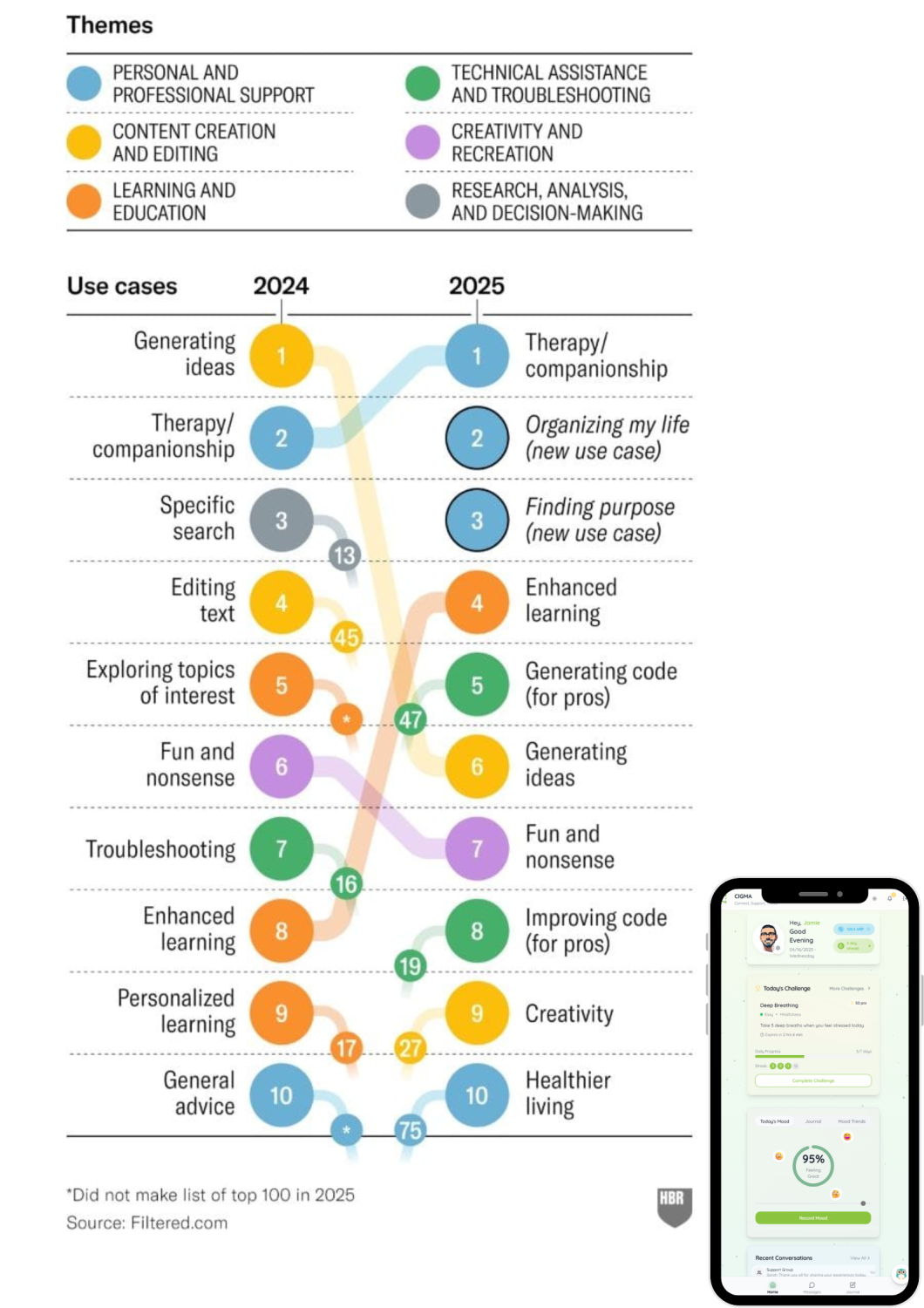 The Top Use Case of Generative AI in 2025 is Therapy/Companionship. Source: HBR
Beyond Mental Health: The Broader Digital Implications
The COVID-19 pandemic dramatically worsened this crisis, causing a 25% to 28% increase in anxiety and depression worldwide.[^81] Depression and anxiety disorders now cost the global economy $1 trillion in lost productivity each year.[^84]
The disparity in mental health resources is stark. Europe has an average of 45 mental health workers per 100,000 population, while low income countries have just 1.4 per 100,000 people. In Africa, there is only 0.1 psychiatrist per 100,000 people.[^87]
Digital only care can democratize access in ways that traditional models cannot. A peer coach in Mumbai can support someone in rural Maharashtra. A gamer struggling with anxiety in Lagos can connect with others facing similar challenges across Nigeria. Clinical expertise can be distributed globally while cultural competency remains local.
We're already seeing this potential in our closed beta. Users from multiple countries are participating in peer support networks, sharing experiences across cultural boundaries while
The same principles (proactive engagement, behavioral intelligence, peer support) can transform chronic disease management, preventive care, and primary care broadly.
Consider diabetes management. Instead of quarterly check ins reviewing past data, imagine continuous support that prevents crises before they occur. Real time feedback on lifestyle choices. Peer support from others managing similar challenges. Predictive interventions when patterns suggest complications.
Consider cardiovascular health. Instead of annual physicals that catch heart disease after damage is done, imagine continuous monitoring that detects irregularities in real time. Wearable integration that tracks heart rate variability, blood pressure trends, and activity patterns. AI that recognizes early warning signs of cardiac events days or weeks before they occur. Personalized interventions that adjust medication, suggest lifestyle changes, and coordinate care seamlessly between cardiologists and primary care providers.
Consider women's health. Instead of annual exams that miss the daily realities of hormonal changes, reproductive health, and life transitions, imagine continuous support that adapts to monthly cycles, life stages, and individual needs.
The tech exists, the infrastructure exists, the validation exists... yes, something remains missing.
The Challenges (in Mental Health):
Cultural Competency:
One of the most complex challenges in digital first mental health care is ensuring cultural competency at scale. Mental health stigma varies dramatically across cultures. Family dynamics, religious considerations, and community expectations all influence how people experience and address mental health challenges.
We've learned that one size fits all approaches fail. Instead, we've developed what we call "cultural intelligence": algorithms that adapt interventions based on cultural context while maintaining clinical effectiveness.
For example, in cultures where family involvement is essential to mental health, our peer support networks facilitate family education and involvement, through partner apps. In cultures where individual privacy is paramount, we provide completely anonymous support options. In cultures where religious or spiritual practices are central to healing, we integrate these elements into our intervention toolkit.
 Cultural Contexts Matter
Digital Hesitancy
"Digital care lacks the human touch." This assumes that current healthcare delivery is particularly "human." Most psychologists report that over half (56%) have no openings for new patients, with average wait times of three months or longer.[^34] Most people spend more time with intake forms than with their doctors. Digital first care, when designed thoughtfully, can actually create more consistent, continuous human connection than traditional models.
"People need face to face interaction for mental health." Digital health interventions offer promise in the treatment of mental health conditions and provide a safer alternative to face to face treatment.[^18] Some people do prefer in person care, and we refer them to appropriate providers. But most people find it easier to open up through digital channels, especially when dealing with sensitive topics like mental health, addiction, or trauma.
"Digital platforms can't handle crisis situations." We have robust crisis protocols, including immediate escalation to human crisis counselors and integration with local emergency services. But more importantly, our proactive approach prevents many crises that would otherwise occur.
"The technology will replace human providers." Our goal is not replacement but augmentation. We handle the routine monitoring, pattern recognition, and peer support that doesn't require clinical expertise, freeing human providers to focus on complex cases and clinical decision making where their expertise is irreplaceable.
Why May Is the Right Month to Say This
Mental Health Awareness Month should be a mirror, not just a spotlight. It should make us ask: what are we actually doing differently?
At CIGMA, May is not a marketing moment. It is a reminder of why we started. It is a time to share what we have learned: that digital care is not about efficiency or cost reduction. It is about empathy at scale.
Four years after my father's passing, I am more convinced than ever that the systems we rely on need radical rethinking. We cannot patch and tweak our way to equity. We need new blueprints.
We are building a paradigm. One where care lives in the background of people's lives. Where people do not need to declare crisis to receive support. Where clinical escalation is just one layer in a broader ecosystem of connection, coaching, and self awareness.
Our roadmap includes partnerships with employers who understand that mental health drives productivity. Collaborations with educational institutions facing student mental health crises. Integration with existing healthcare systems that want to prevent rather than just treat. And international expansion to serve the billions of people who currently have no access to mental health support.
This model is not theoretical. It is being tested and refined. And it is desperately needed.
In Memory, In Motion
My father's memory is a motivator. It reminds me that healthcare is not about systems. It is about people. It is about those we love, and those we have lost.
This May, I grieve. But I also build. I reflect. But I also act.
CIGMA is one way of honoring his legacy. By helping others feel held, heard, and healed without friction, without stigma, and without delay.
The findings demonstrate that digital technologies hold promise in bridging the mental healthcare gap during and after the COVID-19 pandemic, when disease news and quarantine measures have terribly threatened public mental health.[^24] Healthcare transformation will not come from the established system. It will come from the margins, from innovators willing to challenge assumptions, and from users who demand better.
Let this be the month we stop talking about what care should be. Let this be the month we start delivering it.
Fully digital. Deeply human. Unapologetically forward.
Not someday. Now.