Full Circle: The Return of Wisdom and the Rise of Healing
· Dr. Ramy Azzam
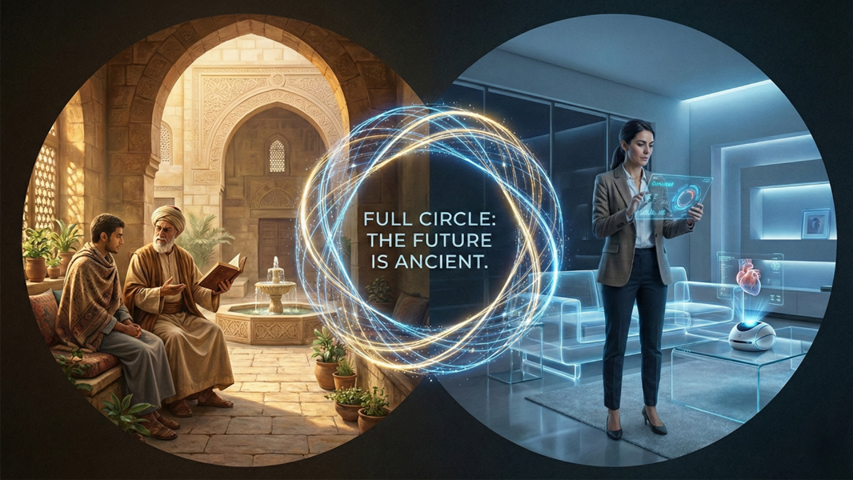
The 5-Year Horizon: A Nonlinear Future
If you read the forecast reports for 2030, the consensus from global firms like Deloitte, McKinsey, and the tech giants is that we are on a relentless march toward a singular destination: "virtual-first," "seamless," and "automated." The prevailing vision is one of hyper-efficiency, a world where agentic AI replaces appointments, sensors augment touch, and the patient is processed through a digital pipeline with minimal human friction.
But, of course, they are wrong! (Rant on the hierarchy of evil, and where consultancy firms sit in that hierarchy is for another post)
Because beneath those ChatGPT generated forecasts, there is a real anxiety. Anthropologists, behavioral scientists, and experience designers are warning us about the rise of "rogue healthcare" and “wild west care”. They, and I am one of them, argue that in the race to unlock generic ROI, we are eroding the ethos and mission of healthcare. We are copying and pasting from other industries without contextual considerations, let alone ethical ones.
The data confirms this disconnect. According to the Qualtrics 2025 Healthcare Trends report, trust in US healthcare providers has plummeted from 71.5% in 2020 to just 40.1% in 2024. As J.D. Power’s 2024 Telehealth Study reveals, satisfaction with virtual care has already hit a ceiling.
The verdict is clear: Patients enjoy the convenience, but they feel processed, not cared for.
This creates a tension that current "hybrid" models fail to solve. We are stuck halfway between the old world of cumbersome physical visits and the new world of stupid digital solutions, masquerading as innovations.
To me, I don’t see a straight line that forces us to choose between efficiency and ethics. I see a circle.
We are (and should be) moving toward a future that looks remarkably like our past, only this time, it is powered by an invisible engine of technology that allows us to scale what was once only possible for the privileged few.
The "hospital" as the center of gravity for care will be an archaic concept. The true center of gravity will return to where it began: the home and the community. True hospital at home, not just rubber-stamped pilots that tick the box.
The Return of the Hakeem
Growing up in the Arab world, many of us hold a cultural memory of the archetype of the "Hakeem" (??????). We saw him in black-and-white films and TV shows or perhaps heard stories from our grandparents.
Hakeem, which literally translates to a wise man, was the physician who carried his bag to the sick person’s home. He didn't just read vital signs; he read the room. He sat by the bedside, drank tea with the family, and diagnosed the environment along with the patient. He knew if the house was damp, if the family unit was stressed, if the food was nutritious. He understood the "Social Determinants of Health" a century before we coined the acronym.

The ancient doctor was a wiseman "Hakeem", who often knew everyone in his community, their contexts and their social determinants.
For the last 50 years, we systematically dismantled that model. We built massive fortresses of concrete and steel, the General Hospitals, and demanded that the sick come to us, on our terms. We traded context for efficiency. We gained MRI machines and sterile labs, but we lost the soul of medicine. We lost the context.
The next five years should reverse this. We are bringing the Hakeem back, but this time, he is technology-enabled.
Imagine a primary care model where the default is not a waiting room, but your living room. This isn't just "telemedicine" where a doctor waves at you from a screen. This is a fully logistical, clinically integrated supply chain of care delivered to the doorstep.
This shift allows us to structurally bifurcate healthcare into two distinct, optimized streams: Transactional Care and Transformational Healing.
Stream 1: The "Hot Clinic" and Transactional Efficiency
For the vast majority of primary care episodes, the ear infections, the rashes, the minor injuries, the routine certifications, patients do not want "an experience." They want a resolution. They want the friction removed.
We will see the rise of satellite community "Hot Clinics." Think of these like WeWork "hot desks" for health. These are hyper-local, small-footprint units embedded in neighborhoods, malls, and corporate centers. They are not designed for lingering. They are designed for speed.
In this model, the patient journey is transactional in the best sense of the word. You walk in, technology (likely invisible AI) authenticates you, diagnostic tools (guided by remote experts or autonomous systems) capture the data, and you leave with a treatment plan in minutes. This is not fiction, it is happening today.
No paperwork. No waiting rooms full of sick people. No entering a long "sick cycle."
This is the efficiency engine. It clears the clutter from the system so we can focus our deepest resources on what actually matters: Healing.
Stream 2: Istishfa (???????) and the Architecture of Healing
If the "Hot Clinic" is about fixing what is broken quickly, the new community centers must be about something entirely different. We need to reclaim the Arabic concept of Istishfa (???????).
In modern healthcare, we focus on Ilaj (treatment/????). But Istishfa means "to seek healing." That’s what the word ?????? the Arabic word for hospital, literally translates to “the place of healing”. It implies an active, holistic pursuit that involves the spirit, the mind, and the environment as much as the body. We have forgotten that hospitals in our region were once sanctuaries for this very purpose, not just repair shops for biology.
We must look to history to design the future. The Golden Age of Islamic medicine didn’t just produce great surgeons; it produced great architects of health.
The Qalawun Complex (Cairo, 1284 AD)
In my motherland, the Qalawun Complex in Cairo was a marvel of therapeutic architecture. It wasn't a sterile white box. It featured immense vertical spaces for natural light and air circulation.

The architecture of Istishfa. the Qalawun complex utilized immense vertical space, natural light and open air courts designed specifically to uplift the spirit of the patient.
The complex featured running fountains in the corridors because the sound of water was clinically understood to soothe the agitated mind. It employed storytellers and musicians playing specifically composed melodies suited for different wards. They understood that you cannot cure the body if the mind is trapped in a dungeon.
The Bayezid II Külliye (Edirne, 1488 AD)
Similarly, look at the Bayezid II complex in Turkey, my other motherland. This facility was an architectural marvel designed specifically for mental health and holistic recovery.

Engineered for sound, the architectural plans show a central hexagonal hall under a dome designed with precise acoustics, so that music therapy and the sound of water could reach patients in the surrounding rooms.
The treatment involved the sound of water from central fountains, the scent of flowers from the gardens, and musical therapy tailored to the patient’s specific ailment. The architecture itself, the use of natural light, the acoustics, the ventilation, was the medicine.

The historical "Hakeem" utilized multi-sensory therapy, understanding that healing requires addressing the emotional state alongside physical symptoms
The Modern Equivalent: Health Care ? HEAL CARE
In the next five years, we must build the modern equivalent of these sanctuaries. But we shouldn't call them hospitals. These will be healing fitness spaces where the mission is not to treat the sick, but to optimize the living. Imagine a facility that combines the sophisticated diagnostics of a longevity clinic with the hospitality of a sanctuary and the community aspect of a high-end gym.
We are already seeing the prototypes of this future emerge. Look at Lanserhof in Germany, where MRI machines and cryotherapy chambers sit within architecture that rivals a modern art museum, proving that clinical excellence does not require sterile ugliness. And The Well in New York, which operates not as a clinic but as a social club for wellness, reintegrating health into the daily rhythm of community life rather than isolating it.

The Well in New York is a social club for wellness woven into communities
This "Heal Care" model is built on three pillars:
No Bloat: We strip away the unnecessary, defensive testing that drives up costs without improving outcomes.
Community Oriented: Just as the ancient Bimaristan was integrated into the daily flow of life (often attached to schools or mosques), these spaces are integrated into the community.
Human Centred: Every individual doing better; all of society doing better.
This is where we move the needle from: "Sick Care" to real “Heal Care”
The Native Tech: Invisible and Essential
Of course, none of this works without modern tech. Tech will cease to be a differentiator or a marketing buzzword. It will simply be the water we swim in.
It will be the invisible layer that makes the logistics of the "Hot Clinic" efficient, routing patients and resources like a finely tuned orchestra.
It will be the predictive engine that tells the modern "Hakeem" which home to visit before the patient even calls, flagging deterioration before it becomes an emergency.
It will be the genomic decoder that allows us to personalize "Fit Care" plans for longevity, moving us from population averages to n=1 precision.
The differentiator will not be who has the tech, but who has the outcomes. The organizations that win will be the ones that use native intelligence to actually make people healthier, not just to increase appointments or increase billing code throughput.
The Executive View: Positioning for Impact
As executives, our mandate in this era is not merely to adopt innovation, but to architect this fundamental transition.
We are witnessing a structural shift where global technology infrastructure is finally pivoting away from walled gardens toward open, intelligent ecosystems, acknowledging that the future depends on data flowing freely to where the patient needs it, regardless of the vendor.
Simultaneously, leading academic medical centers are redefining the very concept of a "smart hospital," moving beyond basic digitization to implement predictive command centers and pioneering genomic leadership that anticipates disease rather than just reacting to it.
And perhaps most importantly, we see bold, integrated enterprises understanding that healthcare is now an entrepreneurial venture into wellness. These organizations are capable of building entirely new verticals that don't just treat patients, but engineer longevity and quality of life.
The future belongs to the leaders who can bridge these worlds, who can build the high-tech logistics of the "Hot Clinic" while simultaneously cultivating the high-touch soul of "Istishfa."
We are going full circle. The Hakeem is coming home. And they are bringing the future with them.