Prompt Waffling: The Art of Rambling Your Way to AI Gold
· Dr. Ramy Azzam

One random evening, I was on the sofa, casually multitasking while chatting with my wife. Phone in hand, I was speaking, well, rambling, into, my phone. Having multiple AI agents listen to my rambles trying to generate something useful. My verbal stream was more jazz than symphony, shifting tones, jumping between tasks, layering context upon sub-context like an onion of confusion. Mid-ramble, my wife glanced over and said, “Who on earth are you talking to? That sounds like absolute nonsense.”
I replied, “I'm talking to AI, just giving it as many details, as possible. It's emmm... Vibe Prompting?!”
She smirked. “Well, it just sounds like you’re waffling.”
And that’s when it hit me: Prompt Waffling.
Like vibe coding, prompt waffling is its natural cousin in the world of large language models (LLMs). It is the beautifully chaotic process of overexplaining, overcontextualizing, and oversharing with AI, trusting it to extract signal from the noise.
What Is Prompt Waffling?
Prompt Waffling is the act of speaking or writing a long, unstructured, often meandering request to an AI model with the trust that it will distill your mess into clarity. It's a mix of brain dump, stream of consciousness, and organized chaos. It is like giving an AI a voice note after a 3-hour brunch, messy, enthusiastic, all over the place, and it somehow turns it into a TED Talk.
Where traditional prompting says “Be clear. Be concise. Be structured,” prompt waffling says, “Here’s everything. Figure it out.”
My British friends will definitely know the term “waffling”, I certainly didn't till a couple of days ago. Apparently, in British slang, it describes someone who talks at length without getting to the point (I know a few people like that). It’s generally not a compliment, but let's see if we can change that.
The Case for Prompt Waffling
Why does this even work? Because LLMs are trained not just on data, but on patterns of language, context, and inference. The more you give them, the more they can draw connections.
Here’s what prompt waffling unlocks:
Contextual richness: Rambling often reveals underlying motives or related tasks you didn’t even think were important to include. The AI captures that.
Emotional intent: The tone, frustration, and even sarcasm in your ramble help the AI infer urgency, preferences, and desired tone.
Task chaining: You might start with “I need to send an email,” but by the end of your waffle you’ve embedded, “I want to impress my boss,” “I’m short on time,” and “I need to align with next quarter’s OKRs.” That is powerful meta-context.
Creative breakthroughs: Like freewriting, prompt waffling surfaces subconscious ideas you didn't know you had. The AI becomes a mirror and editor in one.
It is like dictating a stream-of-consciousness journal entry and having a helpful assistant pluck out the key insights and turn them into a slide deck, blog post, or marketing email.
Prompt Waffling vs. Prompt Engineering
This is not prompt engineering. Prompt engineering is strategic, measured, and often surgically precise, designed to get deterministic outputs from the model. Prompt waffling is its messy, creative twin. Chaotic good.
Let’s compare:
Prompt Engineering: “You are an AI Ethics expert. Write a 300-word blog post on AI Ethics. Include only credible sources such as scientific papers and textbooks. Avoid consultancy firm reports, articles and Wikipedia” Specific, focused, and efficient.
Prompt Waffling: “So I want to explore the topic of AI ethics from the perspective of healthcare. In my work in healthcare and digital health, it is important to not only to explain how AI works but to make sure it is ethical. And also the social aspect of it, it seems people are concerned out about AI taking over, and there’s this whole thing about responsibility and, like, who’s accountable if an algorithm screws up? I want to explore that, but in a way that’s not boring, something that even a non-technical audience would get, maybe using real-world examples or metaphors, as possible an using case studies from the past as proxies. Could be a blog post. Maybe 2-3 mins read max.” Broad, verbose, and exploratory.
Prompt waffling is especially useful when you’re working on ill-defined tasks like brainstorming, ideation, creative writing, or strategy synthesis. It is less effective for coding or fact-based queries where precision is non-negotiable, but for everything else, it is a superpower.
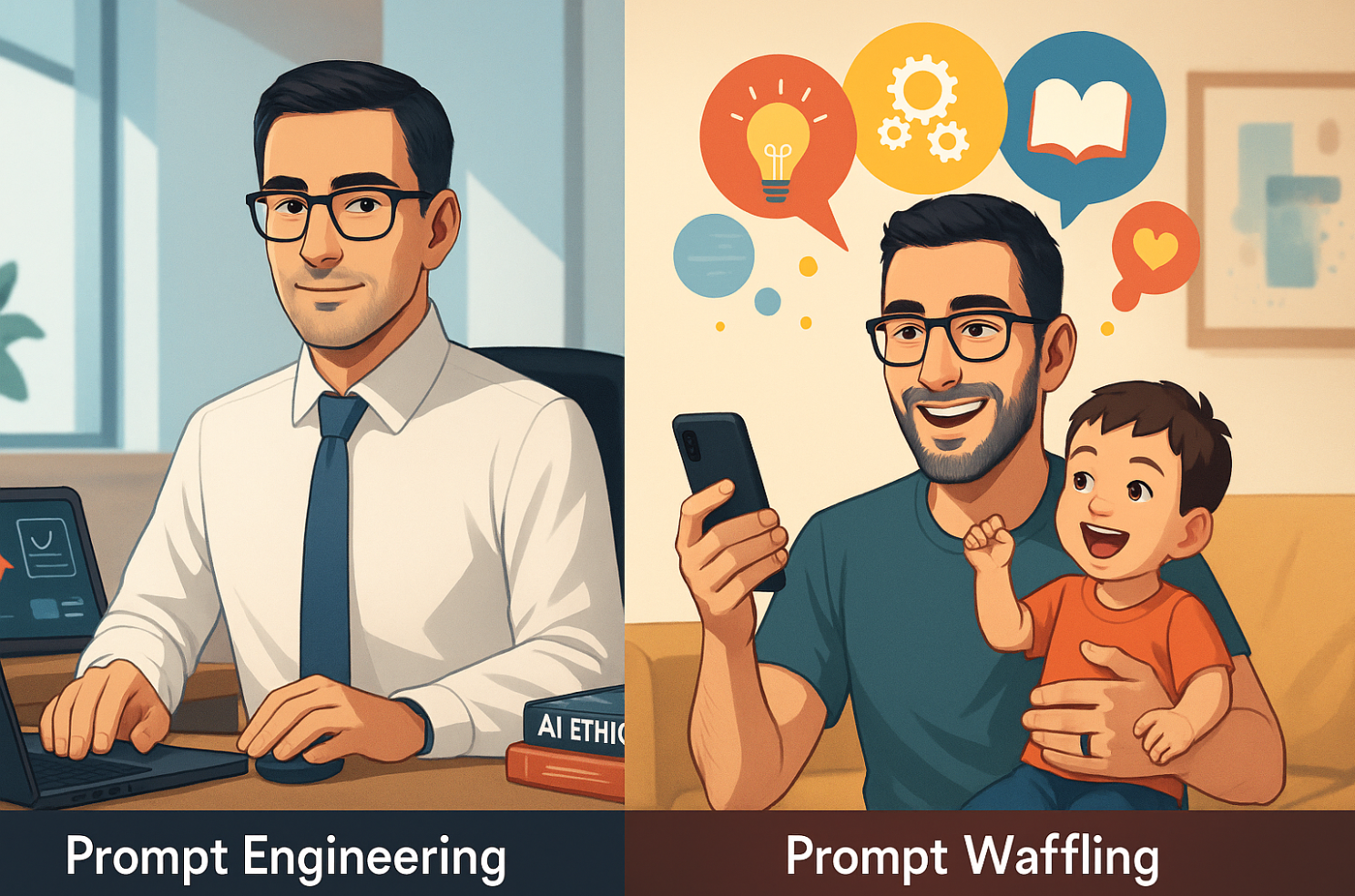 Which one are you?
Waffling in the Wild: Pop Culture Parallels
Pop culture is full of prompt wafflers. Consider:
Tony Stark, talking to JARVIS: "Okay, so let’s try the Mark 42 again. But this time, make sure the suit doesn’t blow up midair. And maybe tweak the HUD colors, that red is kind of aggressive, oh, and remind me to call Pepper. And I think I left something on the rooftop…” Total waffle. But JARVIS gets it.
Rick Sanchez from Rick and Morty: A scientist’s waffle-fueled instructions are essentially gibberish with occasional nuggets of utility, but AI would probably make sense of it.
Michael Scott, describing a marketing campaign: “I want it to be like... powerful. Like the feeling you get when you hear ‘Eye of the Tiger’ but also... like, emotionally complex. Like, ‘The Notebook’ but for business.” Classic waffle. But give that to Claude, and you might just get your tagline.
Even Star Trek’s Captain Picard was a waffler in denial. “Make it so,” was the end of the command, but the preamble often contained tangents, ethical debate, and indirect hints about what he really wanted.

Prompt Waffling in Practice
Here’s a classic example of a waffled prompt:
“Okay Claude, I have this thing coming up next week, it’s like a panel discussion or maybe a webinar? Anyway, it’s on the ethics of AI, which is broad and fluffy as you know, but I want to focus on practical stuff, not just theory. Maybe frame it around real-life implications, like data privacy or clinical AI in mental health? You know I work in digital health, right? Maybe pull some references from that Abu Dhabi panel last year, wait, actually add a point about UAE regulations. I need this to sound professional but also conversational. Let's go”
What Claude hears: “Generate a 5-minute panel intro on the ethics of AI in healthcare, focusing on practical implications like data privacy and regulation in the UAE. Use examples from recent events and keep it conversational.”
Final Thoughts: Embrace the Waffle
Prompt waffling is a celebration of human messiness. It recognizes that while AI may thrive on structure, humans do not always think in bullet points. Our thoughts are emotional, tangled, associative. Prompt waffling bridges that gap.
So next time you’re hesitating to structure your thoughts for an AI tool, just hit record and talk. Talk like you're explaining it to a friend half-listening while scrolling Instagram. Talk like you’re ranting into a void. Talk like you don’t care about structure, because you don’t need to.
The AI does. Welcome to the Waffleverse™
Have you tried Prompt Waffling? Does it work for you?