Welcome to Innovation Theatre
· Dr. Ramy Azzam
Lights, camera, wearable
A conference hall the size of an aircraft hangar hums with expectation. Spotlights sweep a neon blue stage. A host in geeky glasses and a yellow blazer strides out, holding something that looks suspiciously like a glorified fitness band. The crowd leans in.
The band glows.
“This widget will spot sepsis before the attending physician finishes her morning espresso”. Cameras click. Feeds ignite. For a few glorious minutes everyone is certain that medicine has finally levelled up.
Fast forward six months. The band gathers dust in a clinic drawer. The pilot stalls in procurement. The clinical champion moves on to his next shiny thing.
Curtains fall. Applause fades.
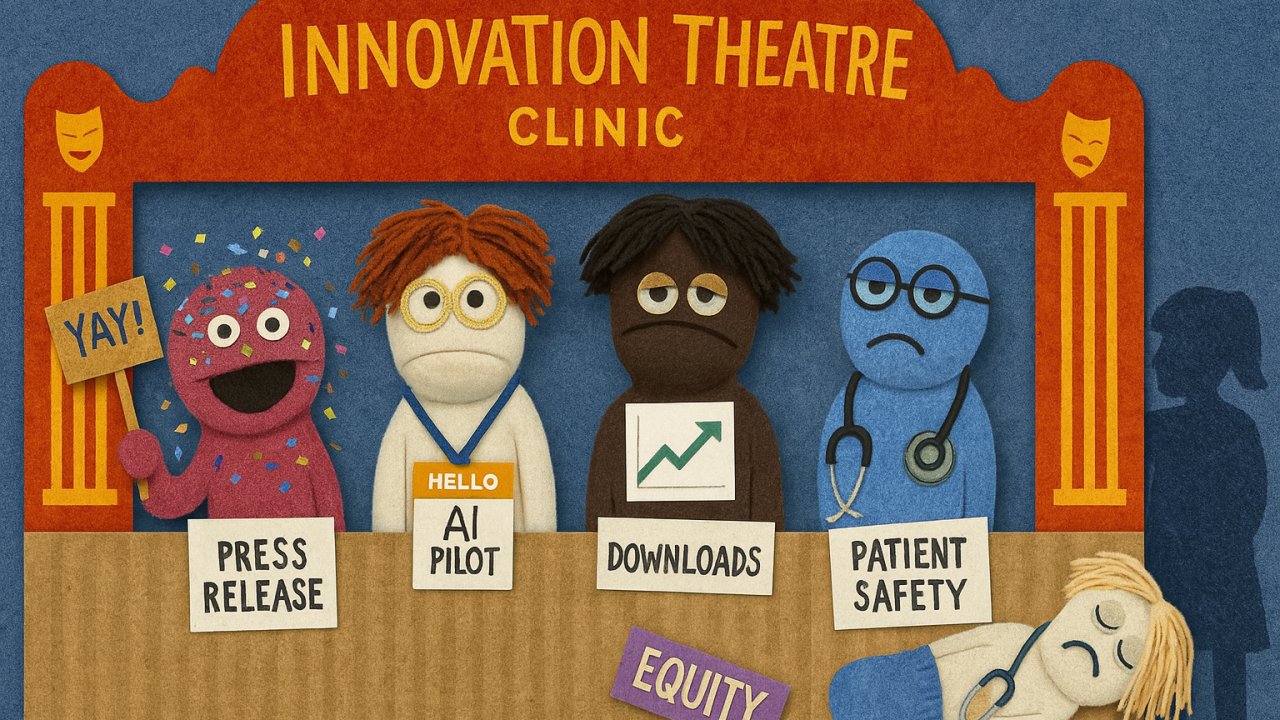
Welcome to innovation theatre in healthcare, where the promise is blockbuster yet the box office returns are small.
What we are really watching
Innovation theatre is not a scam. It is a cousin of genuine experimentation that prizes perception over persistence. We run small pilots to de risk new ideas. That is sensible. Trouble starts when the pilot becomes a holding pattern. We end up with an endless loop of Groundhog Day demos that consume time, money, and goodwill while patient benefit remains unproven.
The script is familiar.
A start up joins a university hospital to trial an artificial intelligence triage model. Sensitivity and specificity look impressive on paper, yet connecting the tool to the medical record proves harder than a midnight shift in the ER, and a year later the algorithm is an academic footnote.
On the exhibition floor, everywhere is glittered with consumer wearables that promise to detect atrial fibrillation, predict stress, and remind users to hydrate. Some deliver, some do not. Many were trained on marathon runners rather than typical heart failure patients, so regulators raise eyebrows and the spotlights fade.
And then there are hackathons. Over seventy two pizza fueled hours, teams conjure chatbots that will transform patient experience. Energy is infectious and slides sing until Monday arrives, when privacy, safety, and data access land like a sack of wet cement.
Back at headquarters a health system unveils a futuristic innovation lab packed with virtual reality headsets and bean bags. Executives tour, marketing captures the moment, and after two years many ideas exist yet few enter routine care because the procurement catalogue never opened.

Innovation Hackathons, Broken Foundations
Then, why do we keep buying tickets?
Innovation theatre survives because a potent mix of instinct, structure, and culture keeps drawing crowds.
First comes FOMO: no executive wants the rival hospital to claim the headline about mixed-reality ward rounds, so leaders sponsor quick pilots that generate publicity while long-haul rollout quietly stalls. Often these programs live inside freshly minted two-person “Digital Innovation” departments with little mandate that end up creating more meetings than momentum.
Next, we have the outsider executive, a consultant imported from retail loyalty schemes or cloud infrastructure who wields buzzwords like a ninja; armed with an arsenal of online credentials, they green light projects that thrill executive committees and keep ward teams frustrated.
Venture capital adds its own gravity, rewarding traction metrics long before a clinic can show safer workflows or fewer readmissions, leaving hospitals and innovators talking past each other.
Measurement bias compounds the problem: downloads and demo videos are easy to report, whereas quality-adjusted life years (QALYs), total cost of ownership, and equity impact are just “not worth the investment!”… wait, what?
Layered atop all these forces is cultural friction; clinicians, acutely attuned to empty publicity, disengage when they are not true co-designers, and enthusiasm evaporates as soon as external advisers pack up.
The bill for this spotlight is steep. Opportunity costs rise when scarce funds flow into showcase pilots instead of critical infrastructure like cybersecurity, integration middleware, or the additional nurse educator the wards requested. Clinician fatigue deepens each time front-line staff are asked to adopt yet another scribing prototype, so surveys start landing with a thud. Equity erodes because pilots usually enrol early adopters with premium smartphones, leaving users with everyday tech out of both the data and the solution. Finally, financial leakage staggers billions into projects that never leave the sandbox, capital that could have paid for a root cause procedure to fix the infrastructure of it all.
A Segue to American Theatre
Everyone has been talking about the US AI Action Plan, which fits well into this narrative. Last week the United States announced a national plan for artificial intelligence that promises federal investment, faster approvals, and a single rulebook across states. Supporters argue that common rules reduce confusion for multistate health systems. Critics warn that labelling state rules as burdensome risks drifting toward deregulation, with limited attention to bias audits, healthcare safety, or clear guardrails for high-risk use such as diagnostics.

Lights, Camera, Action!
My message for healthcare leaders is simple.
Treat policy headlines as context, not as a green light for shortcuts. Strong governance remains non-negotiable.
So, what are the #Ramyfications?
Start with what keeps everyone up at night. Which pain point hurts most, for whom, and how will we know when the pain recedes. Write it in plain language that survives executive turnover.
Choose a rigorous evidence framework. RE AIM, CFIR, or the NICE Evidence Standards bring structure. Less glamorous than a fireside chat, more useful when the cameras leave.
Align incentives early. Put information technology, legal, procurement, finance, a ward nurse, and the clinical sponsor in the same room. Agree on success measures and how each party will be rewarded when those measures are met.
Budget for the long haul. Pilots run on grants and goodwill. Adoption runs on operating budgets, training, and maintenance. Identify reimbursement pathways or revenue streams that live beyond the press release cycle. :Hint: VBC or D2C
Embrace implementation science. Publish protocols. Share negative findings. Iterate with users. Projects that co design, measure fidelity, and adapt to context are far more likely to survive.
Write a sunset clause. Every pilot needs an exit strategy. If milestones are missed, end it gracefully and share lessons so others do not step on the same rake.
Invest in data plumbing. FHIR/openEHR, robust consent, clear data stewardship. Not as photogenic as augmented reality, absolutely essential.
Final curtain
Innovation theatre is fun. It sparks imagination and sometimes unlocks funding.
But if the spotlight distracts us from data cleaning, workflow mapping, and change management, we risk turning care into an endless talent show where applause is loud and patient benefit is quiet.
Enjoy the demo. Take the photo.
Then ask the unsexy follow ups.. Who owns the data? How does it integrate with current pathways? Who funds maintenance after year one? What is the plan for equitable access?
Get those answers and you turn a matinee into a national tour. That is theatre worth buying tickets for.